Episode Transcript
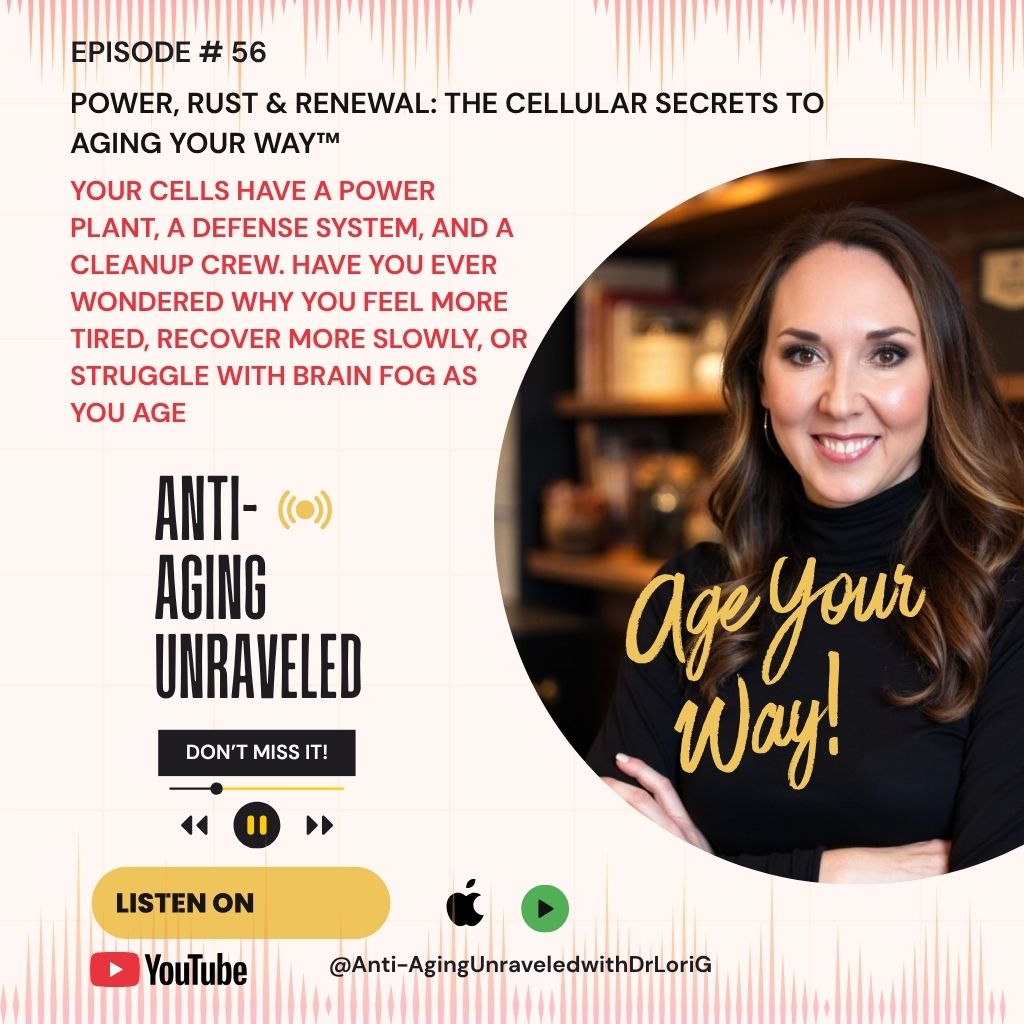
[00:00:00] Hi, everyone. This is Dr. Laurie. I am back and I'm going to try to do this again. I've been having some technical issues with podcast recording, so we are going to make an attempt to get this one into the books. And I'm really excited to bring this topic to light. We are doing some really fun things with advertising on sports radio right now with WIP in Philadelphia. And this actually came up from one of my patients, and it's a really good question. It's a really good topic. It's something that I feel like I don't talk enough about until I get in front of a patient. So we're gonna dive right into this one. And the topic today is power, rust, and renewal. And we're gonna talk about how your cells make energy fight oxidation and take out the trash and what that means for actually aging your way. And that's what we like to practice and preach here. Right? So I think this is a topic that is in the press and the media right now. We're gonna talk a lot about NAD and detox mechanisms, so stay tuned and keep listening.
[00:01:00] Welcome to Anti Aging Unraveled, the podcast where we redefine aging and empower you to age your way. I'm Dr. Laurie, and this show is rooted in the life jevity philosophy. Living life the way you want to with energy, clarity, purpose, and longevity. Here we break down integrative functional medicine, bioidentical hormones, peptides, metabolic and brain health, gut, immune connection, and cutting edge longevity therapy piece. So you're not just living longer, you're living better.
[00:01:32] If you believe aging should be intentional, personalized, and on your terms, you're in the right place. Welcome to Anti Aging Unraveled. Let's unlock longevity and help you age your way.
[00:01:47] All right, here we go.
[00:01:48] Have you ever looked in the mirror and thought, well, all right, I don't feel as old as I look. Or maybe the opposite. I don't look that old, so why do I feel that tired? And. And you sleep eight hours, wake up exhausted. You walk into a room and forget why you're there. The workout that used to energize you now wipes you out for days. Your skin looks dull, your recovery is slow, and you keep telling yourself, well, I guess this is just getting older. And here's what I want you to hear today. If that sounds like you and I, truthfully, I think it sounds like all of us. And it's what we like to call normal aging, but that actually starts inside your cells years before we ever see it in the mirror. And it starts with how your cells actually make the energy, how they handle that wear and tear, and how well they're able to take out the trash. If you say anything like, my house, not very well. My son never takes out the trash when he's supposed to. And that's the encouraging part though, is that it's modifiable. We can measure it. Yes, I'll say that again. We can measure it, we can support it, and in many people, we can actually slow it down.
[00:02:49] So I think that that's really important distinction. And in today's episode, we're going to really dive deep into what I think is the most fundamental level of health there is, which is that cell. We're going to talk about four things that are tightly connected. Number one, your mitochondria and ATP. They are what makes the energy okay. Number two, oxidation and free radicals. What are they? What's oxidative stress, what that means and why more antioxidants isn't always better. And number three, that buzzword NAD or nad, the molecule everyone's talking about, what does it do? Why does it decline and what can we do about it? And that last one, for cellular debris that trash the damaged proteins, worn out mitochondria, what we call zombie cells that pile up with age. And how we clean that house out, we're gonna get very practical.
[00:03:42] Walk you through what we're actually doing in integrative medicine. The testing, the lifestyle modifications, nutrients, advanced therapies. And I'll finish with the question I get asked most. This is what it is, Dr. Laurie. What will I actually feel? What symptoms will actually get better? Right? So we're gonna. We're gonna finish it off with that. And you know, if this is resonating with you already, here's the thing. You can go right onto our website. You can click Get Started. Now, sign up for an appointment to talk to one of our medical professionals or our intake specialist, and we'd love to get you started.
[00:04:15] So let's start with energy. Every single thing your body does. Your heart beating, your brain thinking, your muscle moving, your skin repairing itself, your immune system fighting off a cold, that all runs on ATP. That stands for adenosine triphosphate. But what I want you to think about it is energy currency. It's the cash your cells spend to get anything done. And this is honestly a fact that amazes me every time I think about it. Your body doesn't store a lot of ATP at all. It constantly makes and spends it all the time. So over the Course of a day, you recycle roughly the amount of ATP equal to your own body weight. So you're quite literally an energy making machine around the clock. And that ATP has to come from somewhere. And the vast majority is made inside those little tiny cells called mitochondria, you know, the powerhouses from high school. And while that's true, it's a little bit of an under cell, because mitochondria are big signaling centers.
[00:05:12] They also help decide when a cell should repair itself, when it should divide, when it's too damaged and needs to be retired.
[00:05:19] They're also involved in hormone production, inflammation, and how your brain handles stress. So you know, they're not just responsible for energy. And some cells just don't have a lot of mitochondria.
[00:05:31] Others have thousands. And you can probably guess which tissues have the most, the ones that work the hardest, your heart, your brain, your muscles, your eyes, your eggs, if you're a woman. And that is why when mitochondria start to struggle, the first symptoms that people notice is energy, thinking issues, muscle stamina, and recovery. So those are the high demand tissues, and they feel the shortages first.
[00:05:55] So let me give you a sample picture of how this power plant works. You eat food, carbohydrates, fats, proteins. Your body breaks that food down into small pieces, hands those pieces to the mitochondria. Inside the mitochondria, those fuel molecules pass electrons down what I like to call the bucket brigade, a series of protein complexes called the electron transport chain. And each station passes the electron to the next at the handoff. A little bit of energy is captured during this handoff every time it goes down the line.
[00:06:28] At the very end of the line, the electrons are handed to an oxygen.
[00:06:32] That is why, literally, you breathe oxygen you just inhaled is headed to your mitochondria to be the final catcher in that bucket brigade. And the energy capture along the way is used to make ATP. Okay, now hold on to two ideas because they set up everything else for this episode. First, that bucket brigade needs help. Electron transfer chain needs specific nutrients to run. You've heard of these CoQ10B vitamins. Magnesium, iron, copper, and something called NAD, which is the handoff partner that carries the electron in the first place. It's that first part of the bucket brigade. When those helpers run low, energy production slows down no matter how much you eat. Okay, number two, the bucket brigade isn't perfect. Electrons slip out and leak before they reach the end of the line. When those electrons leak and bump into an oxygen too Early. It creates something called a free oxygen or a free oxygen radical. That brings us to our next topic. So think about this. If it's speaking to you, if it's exciting, if it's interesting, if you're just tired all the time, I want to know what's going on. Please like more of our podcasts, like our whole podcast channel. It helps you get more of our Pods, especially in YouTube. If you're watching this on YouTube, like us on YouTube and like our channel, it'll help you get more videos like this and ours. It'll let you know as well when they come out.
[00:07:55] All right, you've probably heard the words free radicals and antioxidants on this side of a lot of your products. So let's take the marketing out of it and talk about what's actually happening. A free radical is a molecule that's missing an electron. It's unstable, and it wants that electron back, so it grabs it from whatever is nearby. A fat in your cell membrane, not good. A protein, or even your DNA. When it steals that electron, it damages the molecule it stole it from, which can become unstable itself. This is what we call oxidation. This is that rust, right? It's a power rust. So the best analogy I know is the rust. You leave a bike out in the rain, and oxygen reacts with the metal, and it rusts. When you cut an apple and it turns brown, that's oxidation inside your body. That happens as well. It's a similar type of chemistry, and scientists call that a reactive oxygen species. Ros. Here's the part that wellness really doesn't get right. Free radicals are not all bad. You need them. Your immune cells use them as weapons of mass destruction to destroy bacteria. At low levels, free radicals act as signalers or text messages that tells yourselves, hey, we're under stress. Come on, let's get stronger. When you exercise, that's part of what tells your body to build more mitochondria and upgrade its antioxidant defenses. It's a good thing. So the goal is not zero free radicals. The goal is balance.
[00:09:16] Researchers call that redox balance. And when redoxin radicals outpace your ability to neutralize and repair them, the imbalance is what we call oxidative stress. What tips that balance? Well, a lot of them are obvious.
[00:09:32] Chronically high blood sugar, excess body fat around the middle. Smoking, vaping, heavy alcohol, poor sleep, chronic stress. Emotions, right?
[00:09:42] Environmental stress. Here's one of my buckets. Air pollution, heavy metals, molds, pesticides, plastics. Sack. My second bucket. Infection and chronic inflammation.
[00:09:52] And of course, the UV exposure on the skin over time does it as well. We see this all the time in cosmetic dermatology.
[00:09:59] So overtraining recovery is a big one, too. We train, train, train, and don't allow our body to rest.
[00:10:04] And of course, the obvious is just age, right? Because the mitochondria just age. And the bucket brigade gets leakier. They feel they make more free radicals just doing their normal job, that vicious cycle. Damaged mitochondria leaks more free radicals, free radicals damage more mitochondria, and around and around it goes. And that is what we consider to be one of the hallmarks of aging. So if you want to take one thing out of this, it's that one of the hallmarks of aging is this ability to keep the mitochondria healthy. Okay. Or anti aging, if you will.
[00:10:39] So how does the body defend itself? This is important. Your most powerful antioxidants are not the ones you eat. They're the ones you make. Your cells produce them. One is called superoxide dismutase or sod. Catalase is another one. Glutathione peroxidase. And the master antioxidant molecule, glutathione is another buzzword, right? These systems are switched on by a master controller switch. So think about it like the power switch. That is called the NRF2 or NRF2, right? This is the control panel. When NRF2 is activated, your cells ramp up a whole team of protective and detox genes all at once.
[00:11:18] There's a lot of good things that turn on NRF 2. Exercise, intermittent fasting, heat from sauna, brief cold, so cold. Plunging, colorful plants, broccoli sprouts or floraphane, turmeric and curcumin, resveratrol and other polyphenols. These are mild stressors.
[00:11:37] And scientists and other people in our field call this hormesis, or the idea that small, manageable challenges make the system stronger. It's like a vaccine for your cells, right?
[00:11:49] And that brings me to what we call the antioxidant paradox. Years ago, researchers assumed that if oxidation causes aging and disease, then mega doses of antioxidant vitamins should prevent it. And some of the big trials were very humbling.
[00:12:03] In some populations, high dose beta carotene and high dose vitamin E didn't help. And in certain groups, like smokers, high dose beta carotene was actually linked to more harm.
[00:12:14] So there's actually research suggesting that very high doses of antioxidants taken around workouts even might blunt the good adaptive processes that exercise gives you.
[00:12:24] So my messages in antioxidants are bad, but the smartest strategy is to lower the sources of excessive oxidative stress, support your bodies, build in antioxidant systems and use targeted nutrient based on your individual needs testing. Get those labs rather than just throwing a handful of pills at the problem.
[00:12:43] So more is not always better. You can test and not guess and then you know that better is better. Right? Because we know exactly what you should be taking.
[00:12:53] So again, if this podcast is you want to hand this out to a friend, you want to share it, like it? You can also follow us on Instagram. We'd love to have you. It's Rlori Gerber. All spelled out, but it's D R L O R I G E R B E R. We would love to have you on there. Or just my name, Lori Gerber. D O on Facebook.
[00:13:11] You can also message us directly. I love to answer those questions myself, but as always, like our pod, like our YouTube. And it will get more of these put into your inbox if you will, so you can watch more of our pods. We really appreciate it. So let's talk a little bit about nad.
[00:13:28] NAD stands for. All right, here we go. Nicotinamide adenosine dinucleotide. It's one of the most talked about molecules right now. And here's where hype outpaces the science. So it has two big jobs. Energy bucket brigade. Right. Dropping it down.
[00:13:46] Without enough nad, the handoff slows down and ATP production stops. It's like having plenty of fuel but having a clogged fuel line.
[00:13:54] Number two, repair and maintenance. It is required fuel for very important enzymes. One is called the sirtuins. They're those longevity genes. They are all over social media right now. Sirtuins help regulate metabolism, inflammation, and how your cells respond to stress. They keep your genes being read correctly. Another family is called the parps. Yes. P A, R, P S. And they are the DNA repair crew. So every time your DNA gets damaged and it gets damaged thousands of times a day, your DNA needs these parps to rush in and fix it. They burn through NAD in doing so though. So here's the problem.
[00:14:32] We know that NAD is necessary, but we don't really have the large scale clinical data to support it. Right. It just doesn't exist. We have trends and we have clinical experience, but the large scale data is just not there. There is some data to show there's an enzyme called CD38 that actually goes up with aging. And you can think about it. Like almost like a hole in the bucket of nad. And the higher that gets, the more basically it consumes nad.
[00:15:01] So if we can come up with ways also to decrease that CD38, we can actually start to keep NAD around a little bit longer and more so, you know, how do we support it? Well, we stop draining that bucket, we lower the inflammation, we lower the blood sugar spikes, the excess alcohol, we help sleep, we help with toxic exposure. This is the part that a lot of people skip, right? They just take NAD and think it's gonna work. Doesn't work that way. Two, we boost your own production. Exercise, good sleep, daily rhythm, sleep rhythm, Right. Cause NAD actually follows your body clock, time restricted eating or intermittent fasting. And of course, plant compounds. There's actually some really interesting ones found in parsley, chamomile and quercetin, which is in apples and onions for bringing that CD38 enzyme down. So that can help NAD stay around longer and then last but not least, giving the precursors or nad. You'll hear about nr, which is nicotinamide riboside and nicotinamide mononucleotide nmn. They are precursor molecules of NAD or NAD itself. Okay. And NAD can be given as a lot of different ways. I do like to start with a nasal spray or, or a sublingual, have people get used to it as NAD can be difficult to tolerate. It does create a big oxygen flux and muscle demand when you give it. So it can be very uncomfortable when you at first give NAD as an IV or a sub Q. So I do like to start low and go slow with intranasal or sublingual. I do personally like that better than NMN or nr, but there's lots of controversial, kind of conflicting data on that one.
[00:16:43] So, you know, again, we're still looking for that clinical data. And I can't say that NAD is a magic bullet by itself, but it's a tool in the toolkit, right? It's part of a bigger plan. If someone's inflamed, not sleeping and eating a high sugar diet, NAD is like pouring water into a bucket full of holes.
[00:17:00] We patch the holes first and then we support the nad. Right? And that's when I see people really respond. So. So I think that that's really important to understand.
[00:17:10] And you know, I think just remember when you take nad, you need to make sure you know why you're doing it, what is going wrong in your bucket brigade, right?
[00:17:19] So let's talk about what gets far less attention in the cell, and that is cellular debris and Every day, your cells produce waste.
[00:17:27] The proteins get damaged, misfolded mitochondria wear out. Fats and proteins get that oxidation, or oxidized sugars can also stick to proteins in a process called glycation. They formed what we call ages or ages or advanced glycation end products. Very fitting acronym, because glycation is part of why the skin loses elasticity and why blood vessels get stiff over time.
[00:17:52] So when you're young, your cells are excellent at cleaning up or taking out the trash. But with age, the cleaning crew slows down, the trash starts to pile up.
[00:18:00] Picture your home, which can be mine at times. If nobody took out the garbage for a few weeks, this would still technically work, but everything would be harder, messier, and more inflamed. This is what's happening inside those cells. Your body has three main cleanup systems. Okay, number one, autophagy, meaning eating yourself or self eating.
[00:18:19] It's actually one of the most productive things your cells do. During autophagy, a cell wraps up damaged parts, recycles them into fresh building blocks. It's your recycling program.
[00:18:30] This actually was the 2016 Nobel Prize Medicine award for discoveries about how autophagy works. That's actually how fundamental this is to science.
[00:18:40] The second is called mitophagy. It's very much what you think it is. That's recycling of worn out mitochondria. And this is a huge one for energy. Remember, damaged mitochondria are leaky. They make more free radicals and less ATP. So if your body efficiently removes the bad ones and builds new, healthy ones, a process called mitochondrial biogenesis, your power grid actually gets an upgrade. Right out with the old power plant, in with the new ones. And the third is the handling of what we call senescent cells or zombie cells. And this is actually. This part of the conversation is actually what someone asked me, one of my patients from wip, and when we started doing the mail intakes, they really wanted to understand this process of getting rid of cellular debris.
[00:19:24] These cells specifically are too damaged to function. Instead of dying off like they're supposed to, they linger like zombies. And they sit there quietly and they release these inflammatory signals that are not good, and they damage the healthy cells around them.
[00:19:37] So the nickname for that low grade inflammation or chronic low inflammation is called inflammaging. So senescent cells or zombie cells are thought to be one of those drivers of what we call inflammaging. How do we turn these cleaning crews on then? Right, that's the question. This is where it all ties Together. And autophagy and mitophagy are switched on when your cells sense a little bit of a scarcity. Okay. It goes back to those genes we talked about. When you have periods without food, like an overnight fast with your cells, shift up into cleanup mode. When you exercise with intensity triggers mitophagy. There are key energy sensors in your cells, like one called AMPK to flip on when energy is low and they need to clean up and rebuild. Those sirtuins we talked about, the ones that need NAD are also part of the cleanup signal. So low NAD can mean a slower cleanup crew. Okay. On the flip side, what shuts the cleanup crew off? We don't want to constantly be grazing all day. Chronic high insulin sitting all day, lack of deep sleep. Right. All of these things create a problem. And poor lymphatic drainage and lack of clearing waste products and they build up. So that actually brings me to a really interesting nutrient and some very interesting science. Before I get to it, please do all the things, like our YouTube page, like our video, follow us, follow our podcast, and also go grab that website from mydrlori.com and do an intake so that we can tell you more about this or share it with a friend because it is the holidays coming up.
[00:21:11] Okay. This medicine or supplement is called urolithin A and it is fascinating. It's made by certain gut bacteria from compounds in pomegranate, walnuts and berries. But not everyone's gut bacteria can make it, which is a great example of how gut health and cellular health are linked. I feel like there should be like angels singing over top of me with that one. Right. Gut health and cellular health are linked. Everything's linked. Right. Urolithin A has been studied in randomized, randomized human trials in middle aged and older adults. And in those trials they showed improvements of mitochondrial health, some measures of mitochondrial of muscle strength and endurance. And a more recent study looked at its effect on age related immune changes. Right. So it's a little early, but it's one of the most encouraging data points in this field that I've seen on mitophagy in humans for senescent cells or those zombie cells. Researchers are studying things called senolytics, which help clear zombie cells. So quercetin and fisetin are found in strawberries. We use a lot of quercetin in our histamine products.
[00:22:14] So this is still a lot of animal data. But I will tell you, we are seeing some really good results with getting rid of these zombie cells with quercetin.
[00:22:22] So, you know, this is where I see the future of cellular and longevity medicine going, right?
[00:22:28] And if we can get to the root of that cell and how to clean it up and keep the good cells around and the energy production up. That brings me to my question, right? You understand these four pieces of energy production, oxidative stress, nad, cellular cleanup. So let's put this into practice. How do I use it in the real three method, the retrieve, eliminate, add and then lifelinks. Right? That's the lifelinks. Bring it all together. That's why I love that little tidbit on cellular energy and the gut.
[00:22:57] So we get your story. When did the fatigue begin? Pregnancy, illness stresses, all the things your diet, medications, we put that whole picture together, right? Because for example, a lot of common sense medications affect mitochondrial function and deplete key nutrients. For example, this is a huge one. Statins, lower Q, Co Q10, metformin and acid blocking medications are lower B12. Over time, all of these things mean that your cells are going to work differently. So we want to help support you over time. We whittle away what doesn't serve you and obviously put back in things that are going to be deficient. We look at labs and this is huge. We don't just look at, you know, your traditional primary care labs. We're looking at very specific metabolic function testing. We can look at glutathione status, nad. We can look at your cellular age, your RNA aging, your DNA breakdown. Of course, we can do a full thyroid, a flu, full inflammation, insulin levels, all the other stuff, vitamins and minerals.
[00:23:58] I think it's really important to look at organic acid testing. How are your mitochondria being supported and what nutrient pathways are functioning? What does that oxidative stress look like? We can look at all of these things, okay? The goal is to find your bottlenecks.
[00:24:12] Not everyone needs everything, right? So where does your cell or where does your problem lie? And then we patch those holes in the bucket, right? We want to make sure everything's working. We want to fix all of those buckets that I like to talk about on all my other podcasts. Stabilize blood sugar, food sensitivities, exposures, toxins, right? Chronic bug, alcohol, lifestyle choices. We want to stop that consumption or over consumption of NAD and lack of ATP production and the free oxygen radical production.
[00:24:44] So, you know, we want to make sure that that liver is functioning at a top level. We look at alcohol, honestly, because alcohol consumes NAD as your liver processes it. If you've ever felt wiped out and this is me the day after a couple glasses of wine. That's the reason it consumes, and it's one of the reasons it consumes so much nad and you just don't have enough to create ATP the next day, right? We address those toxins. We try to get everything as pure as, you know, within reason that we can, right? Because we know that there are major sources of oxidative stress or holes in your bucket. And then now we add back in the foundational products, right? We're gonna add back in your good exercise, your good sleep, your zone two training, short bursts of high intensity. We're gonna help you with some intermittent fasting. Maybe we eat the colors of the rainbow. We get tons and tons of polyphenols and carotenoids to help activate your own antioxidant systems. Pomegranates, blueberries, things like that, right? And we wanna make sure that you're getting enough protein to protect those muscles as well.
[00:25:49] Omegas, fish, oils, all the things. If we don't get this into your system and start working on your own natural production, all the replacement in the world will not be enough. Okay, we also wanna work on sleep. Seven to nine hours a night, consistent schedule. Cool, dark room, right? And NAD production will go up. Hormesis, we need those healthy stressors. Sauna, the cardiovascular burst, brief, cold, all right, they're not required, but they do a great job with resetting these pathways and then obviously working on breath work and sleep and meditation. Meditation has been proven to reset cortisol and it will help with that NAD production as well.
[00:26:29] Last but not least, we give you those targeted nutrients. We get back and give you back the things that you're missing. CoQ10, if you need CoQ10. B vitamins. If you need B vitamins, you know, your folate and B12 and B3 and B2, your CO factors in your energy pathway. Ala. Ala is a big one. It's a unique antioxidant that works in both water and fat and supports mitochondrial enzymes. So it's a really big one to help recycle antioxidants. It's also been studied for blood sugar support. So we love ALA as a support structure. Glutathione, the master antioxidant. Again, a key detoxifier. But we can measure that and see how your body's doing with that as well.
[00:27:10] But it often helps with nac, right? Which is nac.
[00:27:15] And NAC will actually help with, actually with glycine as well to help improve their own glutathione levels. All right, so it's kind of like a cycle or a slippery slope. We don't always have to give glutathione directly. We can give the building blocks. We can give nac, we can give glycine. Right. So that is definitely an option. And. And creatine. We think of it as a supplement, but it's really an energy buffer. It helps your cells regenerate ATP very quickly in the muscle and the brain. And actually for women, the research Data is growing.
[00:27:46] Omega 3s. That goes without saying, but it's the cell membrane to help with inflammation. Pqq another one. It's been studied for the help with the creation of new mitochondria. Polyphenols. This is. I feel like polyphenols are such a buzzword as well. Resveratrol, quercetin, turmeric, or curcumin and sulforaphane. They're all NRF2 activators. Again, turns on that power grid, right? It's that light switch. So I think that getting those things back into the conversation and then, of course, nad support options is key after the other steps. And then last but not least, there's lots of fun things to talk about with advanced therapies.
[00:28:29] So, again, you guys, if this is something that you're interested in and you love the integrative medicine and you like the way that I bring this to the conversation, please continue to like us on YouTube, share our posts on Insta, and even share our podcast with people. If you want, go to mydrlori.com we would love to have you as part of our VIP member right on our VIP page. That'll also give you special access to pods and things and teachings that you would not get otherwise. So please become a. I would say a loyal listener of anti aging unraveled and our system that way. All right, so what else can be done beyond these nutrients? There are many advanced therapies that we can talk about. We're gonna go really briefly on these, just so that you have an idea. Red light therapy, which is photobiomodulation. There are certain wavelengths of light that are absorbed by a component of the mitochondrial transport chain. And research does suggest that this might support energy production, tissue repair, and skin health, which is why it's so popular in aesthetics and recovery.
[00:29:33] Methylene blue. I use this a lot. It's an alternative electron carrier in the mitochondria. It's like a detour around that traffic jam. So it's really interesting for energy and cognition, but obviously there are always side effects with certain things. So this one actually can interact with many SSRIs and antidepressants. So we do have to be careful of that. Okay, then we get to the peptides. So many peptides. But like mot C helps why? Because it's naturally made by your mitochondria. So we're help, we're researching that for mitochondrial health, metabolic health and exercise help.
[00:30:08] Also I would say hormone optimization often gets overlooked conversations about cellular energy. Really we should talk about estrogen, testosterone and thyroid hormone because they influence how many mitochondria you have to start with and how they work. So for many women in perimenopause and menopause, and men in andropause, if you will, correcting the hormone imbalance is the one of the first and most primary steps in the big energy suck, right. Of NAD and ATP production.
[00:30:37] So and that brings us to the last step in MyReal 3, the method. The Cellular health Life Link is one of our seven life links. It runs alongside all of our others and they're always connected. And I hope that this really has shown you, especially with the urolithin, a connection that your gut ties this all in, your hormones ties this all in. Your detox pathways lower the toxic burden. Right? Your metabolic health drives your blood sugar and that can cause glycosylation or glycation if it's wrong.
[00:31:08] And also can drive to have the holes in the bucket, really Right. Your hormones regulate your mitochondria. You can't fix just one link without looking at all the others. And that is why when you do something at the real three with Dr. Lurie, one of my programs, this is a long term partnership and participatory process.
[00:31:27] It's not just a one time supplement list. We meet with you regularly and things are constantly progressing and changing.
[00:31:33] We retest, we test, we adjust, we optimize, we bring you the newest things that are on the market. And we're constantly striving to look at the best in clinical outcomes. Regardless of pharma companies or anywhere else that things are coming from. We try to do the safest, most advanced healthcare for you. And that is why we want you to age your way. And that is one of the reasons that is our motto. This is really you driving the bus. You tell us how you want to feel and what you want to accomplish and we will use these seven lifelinks and the REAL three method to get you there. So on that note, I did promise you one more thing. The one question, what will you actually feel before I sign off.
[00:32:13] So I'm going to do this as quick as possible.
[00:32:16] Let me start with a story. This is a blend of a bunch of people. Okay? Several patients. It's going to be super familiar. Picture a woman, early 50s, busy career, grown kids. She takes care of everyone. She comes in and says, my labs are air quotes, normal, but I'm exhausted by 2 in the afternoon. My word recall in meetings is off. And I used to love hiking and now I need two days to recover and I look tired all the time.
[00:32:39] When we dug in, we found a lot of small things adding up. Blood sugar spikes from grab and go. Diet a glass or two of wine most nights. Low magnesium and borderline B12, a statin that had never been paired with CoQ10. Poor sleep from menopause. Inflammatory markers that were quietly elevated. No single dramatic finding. Just a lot of little cumulative holes in the bucket. So what did we do? We patched the holes, we balanced her plate, we added a wok after dinner, she cut back on wine.
[00:33:10] We noticed her hormones. We adjust her hormones and her sleep, replaced the nutrients she was missing, added Coq10 right after that foundation was in place. We layered in nad. Within about six weeks, she told me in the afternoon. My afternoon crashes were gone by three months, she was back on the trail and she has her brain back.
[00:33:29] That's the kind of change that's possible when we treat the whole person.
[00:33:33] Everyone's different, right? Obviously. But when we support mitochondrial function, lower oxidative stress, support NAD and improve that cellular cleanup. The improvements I see are dramatic. Energy levels, more even. Not jittery kind of energy, but just a steady energy. You wake up saying you slept. Clarity.
[00:33:54] Your brain uses about 20% of your body's energy, even though it's only about 2% of your body weight. So it's really important that energy. When cellular energy improves, we need brain fog to lift focus, sharper, word recall, exercise tolerance and recovery, muscle strength and stamina. You don't feel you got hit by a truck after a workout anymore. A better sleep quality, more stable mood. This is very interesting because you actually have a steadier energy state. They're more emotionally stable, able to handle stress. Skin, hair and nails get better. Why? Because your cells are constantly renewing and you notice actually that everything looks a little bit brighter and healthier.
[00:34:32] All the metabolic lab markers look better. Insulin, triglycerides, blood sugars, easier body composition. Right. We lose weight and believe it or not, inflammation related aches and pains will decrease. So of course, longer Health goals are always our priority.
[00:34:49] Supporting your heart, your brain, your muscles, and your resilience for decades to come. And that's the prevention side we can't always feel. But if you're asking me what we feel, what I just said previously is what you feel.
[00:35:00] So, you know, the prevention part is what shapes the next 30 years. I will say in general, it takes a little while to feel the difference. It is a few weeks to months. But it slowly improves over time. And those lab markers will take a little bit of time to correct. But when they start to correct, it's actually pretty dramatic, about three to six months.
[00:35:19] So we want to make sure that we give it enough time. Right. And we give it enough, I would say, trust in the process.
[00:35:27] So I think that we've cleared up some myths. If antioxidants are good, more of us be better. Wrong. And nad, NAD IV will fix or sub Q or sublingual will fix me. Nope, not by itself. Right.
[00:35:40] Fatigue is not just part of getting older. Everyone likes to say it's part of getting older. Yes. I'm not saying some changes come with age, but persistent exhaustion and brain fog are not really normal.
[00:35:51] And then, you know, I think that number five supplements are natural, so they're always safe. And I think this goes without saying, but natural doesn't mean risk free. And it doesn't mean that there's not a way to do them the right way, like, for example, methylene blue. So just make sure that you're using a provider and someone that really understands how these systems work. Okay?
[00:36:11] So I think in bringing this home, if you're ready for a deeper, more personalized plan with testing and a strategy built around your body, that's exactly what we will do. At the real 3 method by me and my team. You can absolutely fill out an intake and get started. You can hit us up to message us. We'll more than happily give you more information. We do have a text line which is 215-259-8773. You can also text that line.
[00:36:38] And I think that, you know, just take one small step this week. You know, whether it's a walk or a full night's sleep or adding color to your plate, those are three simple things you can do just to help that natural production of NAD and ATP. So until next time, guys, I'm really excited to take this journey with you. Thank you so much for spending time with me. And don't forget, if this episode was helpful, please, please, please share it with someone you care about. Our black Friday and Pre Black Friday specials are coming so go right to our homepage and you will see on mydrlori.com we have the VIP Black Friday all month of November specials out. We have a great foundational panel that is great as a gift and it comes with a personalized based on your results printout of those results.
[00:37:26] And of course you can always add a lab review to that as a gift. So until next time, take care of yourselves, age your way, and of course, take care of those cells.
[00:37:37] Thanks for joining me on this episode of Anti Aging Unraveled, where longevity is personal and you're empowered to age your way. If you found today's episode helpful, be sure to subscribe to the podcast or our YouTube channel, Anti Aging Unraveled. And of course, follow us on Social for more tools, insights and conversations rooted in lifeevity philosophy, living life the way you want to take your next step? Visit mydrlori.com, click Get Started now and fill out your wellness or weight loss intake. Today, begin your personalized longevity journey. Until next time, keep living with intention, vitality and purpose. Here's to longevity, lifeevity and aging your way.